An everyday field guide
Rainy-day enrichment: indoor games that use the nose
Some days the walk gets shrunk — weather, recovery, a small flat, a dog who needs rest. Those days don't have to be empty ones: a dog's nose is happy to work indoors, and games built around sniffing, finding and problem-solving use real energy without needing a field.
Indoor games complement exercise, not replace it — and sudden changes in energy or behaviour are vet questions. Sources are linked beside each claim.
Published October 1, 2026 · Last updated October 1, 2026
Why sniffing tires a dog out
A dog reading scent is doing real work — sorting, searching, deciding. PDSA's exercise guidance (opens in a new tab) calls brain games a worthwhile addition to any routine — and notes they're especially useful for dogs currently getting less exercise than usual, which is exactly the rainy-day situation. Play doesn't replace the walk — PDSA is clear on that — but it exercises the mind, eases boredom, and lets a dog do normal dog things like searching, chasing and solving problems in miniature.
The shift in thinking that helps: on a short-walk day the goal isn't to tire the legs, it's to give the nose and brain something to work on. Ten minutes of searching is a different kind of effort from ten minutes of walking — and a settled evening is the usual result.
Snuffle games from things you already own
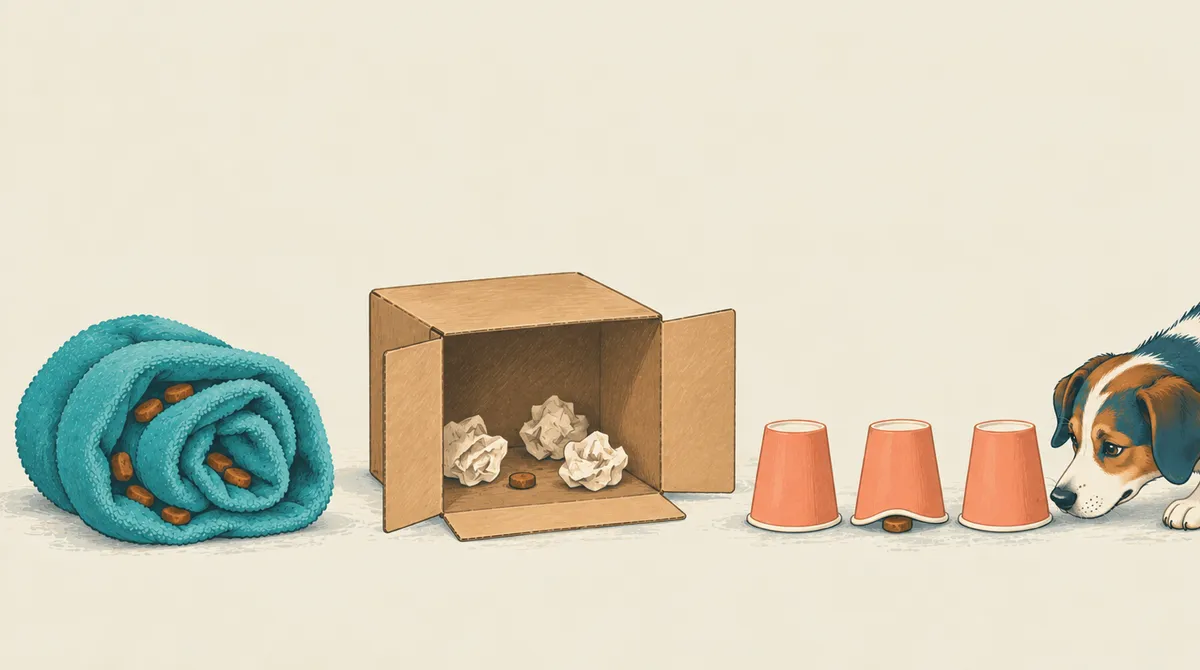
The classic build needs a towel and some kibble. PDSA's home-games page (opens in a new tab) calls the snuffle roll an easy option especially for dogs that need rest — the unrolling is the whole game.
Figure 1 · The towel snuffle roll
Four steps, one towel
- ScatterSprinkle a handful of your dog's normal food or a few treats over an old towel or blanket.
- Roll looselyRoll it up so the food stays trapped inside, with the ends tucked or held closed.
- Offer and watchLet the dog sniff, nose and unroll to free the pieces — the searching is the point.
- Count it as foodWhatever goes in the towel comes out of the day's food allowance, not on top of it.
A snuffle mat is the reusable version: PDSA's activities page (opens in a new tab) describes making one from fabric strips tied through a rubber mat with holes — a shower mat works — with food tucked among the fabric. Bought versions exist too, but the homemade ones work on the same principle: the dog has to forage, not just eat.
Hide-and-seek and find-it games
The simplest scent game needs no equipment at all. PDSA's activities page describes hiding treats or toys around the house: start easy — a few treats under a blanket, or in plain sight around one room — then gradually hide them in different places as the dog learns the game. Each hiding spot should stay safe and reachable; the dog should never have to climb, squeeze or dig somewhere destructive to win.
Dinner itself can become the game: scattering part of a meal across a towel, a clean floor or the garden path replaces bowl-emptying with searching. The rule that keeps all of these honest is the food allowance — treats hidden for games still count toward the day's total, which is why using the dog's own kibble keeps things simple.
Puzzle feeders and destruction boxes (with supervision)
Food toys stretch a meal into a task. PDSA's activities page describes stuffing a treat toy — its example is a Kong — with the dog's wet food or soaked kibble, and freezing it to make it last; if you use peanut butter as a plug, check it's free of xylitol, which is dangerous to dogs — and if you think a dog may have eaten any, contact a veterinarian immediately rather than waiting for symptoms. Slow-feeder bowls do a similar job at mealtimes, and PDSA's exercise page notes puzzle feeders and snuffle mats are useful options while a dog is resting.
Cardboard earns its keep too. The tunnel game on PDSA's fun-games page is just a box on its side with the flaps cut off: toss treats near the entrance, then further in, until the dog walks through happily — later it can become a tunnel under a chair or a line of chairs. A plain box with scrunched paper and a few pieces of kibble is a destruction box in spirit: supervised digging and shredding is fine fun for many dogs, as long as tape, staples and plastic are removed first and the dog doesn't eat what it tears.
Figure 2 · A rainy-day menu
Six games, all indoors
Short training games that double as enrichment
Training and play don't have to be different things — that line opens PDSA's fun-games page, and it's the cheapest enrichment there is. A few minutes of reward-based work is genuinely tiring for a dog, and PDSA's exercise guidance lists training as part of every dog's daily routine because it keeps the mind active and prevents boredom.
Two of the page's games fit small spaces. "Stop" — a stay with a cue — begins with a sit, one step away, then back, rewarding the dog while it's still sitting; the cue word gets added only once the behaviour is reliable, and you build distance and distraction in tiny increments. "Follow me" calls the dog to your side while you face away, then while you're moving — useful recall practice compressed into a hallway. Even a low, soft "jump" — a broom handle resting across two cups, so it knocks off easily — becomes a little indoor course when a dog's joints and space allow. Keep sessions short and end while the dog is still winning.
Safety notes: choking, mess toys and quiet time
Homemade toys follow the same safety rules as bought ones. PDSA's toy guidance (opens in a new tab) is specific: toys should be large enough that they can't be swallowed whole, checked regularly for parts that could be bitten off or chewed loose, and never sticks — splinters and impalement injuries are real. Only leave a dog alone with a toy you're sure can't be destroyed or swallowed — which means shredders get their destruction box only while you watch.
Figure 3 · What enrichment isn't
Watch-outs for indoor play
- Anything small enough to swallow, or with tape, staples or plastic still attached
- Treat games played on top of the day's food instead of inside the allowance
- A destruction box left with a dog that eats what it shreds
- Play pushed on a dog that's already tired, or a sudden energy change used to "tough it out"
A dog that suddenly stops playing, or whose energy or behaviour shifts without a reason, is a vet question — enrichment assumes a healthy dog.
Finally, rest is part of the routine, not its failure. PDSA's stress guidance notes dogs may need around twelve to sixteen hours of sleep a day — a dog that played two rounds of find-it and then chose the sofa isn't bored, it's done. A quiet, draught-free spot the dog can retreat to undisturbed is the other half of a good day indoors.
Sources
- Fun games for dogs at home (opens in a new tab) — PDSA: the snuffle roll build, the cardboard tunnel, and the stop, follow-me and jump training games.
- Five activities to keep your dog busy (opens in a new tab) — PDSA: stuffed and frozen treat toys, homemade snuffle mats, hide-and-seek, slow feeders, and counting game food in the daily allowance.
- How much exercise does your dog need? (opens in a new tab) — PDSA: why brain games matter especially when exercise is reduced, the training-as-routine point, and the toy-safety rules.
- Tips to identify and prevent stress in dogs (opens in a new tab) — PDSA: enrichment balanced with downtime, dogs' sleep needs, safe spaces, and when behaviour changes mean the vet.
Sources last checked 2026-10-01.
Watching your dog work a snuffle roll? A Dog Says Hi photo observation can describe the activity visible in the picture — the photo is sent only after you explicitly submit it, and the AI-generated reading is provisional and can be wrong or incomplete. For the outdoor side of the routine, the exercise guide covers how much walking the week actually needs, and the weather guide covers the days that drive you inside. For sudden changes in energy or behaviour, contact a veterinarian.
Related reading
Indoor play fills the gap in an exercise routine — especially on days the weather shortens.
 How much exercise does a dog need?The outdoor routine these games sit inside — and when to scale it.
 Keep dogs comfortable through changing weatherThe rain and heat that shorten walks in the first place.
- Everyday comfort for a senior dogGentle mental work suits older dogs especially — the low-impact version.
Spotted an error? Tell us.