An everyday field guide
How much exercise does a dog need? Reading energy, age and build
Every chart that promises a universal daily number is guessing. What a dog actually needs depends on their breed background, their age, their build, their fitness — and most of all on the dog in front of you. Here's how to read those clues and adjust the routine.
This guide is about everyday exercise, not a conditioning plan. Sudden changes in stamina, lameness, or breathlessness are vet questions.
Published October 1, 2026 · Last updated October 1, 2026
There is no single number — and why
PDSA's exercise guidance (opens in a new tab) lists what actually moves the figure: breed, age, health, fitness, and personality. Two dogs of the same size can need very different amounts — a number on a chart is a starting guess, and the dog's own response is the measure.
Breed background is a real clue, but only as history. The AKC's guide to the seven breed groups (opens in a new tab) explains that each group was developed for a job — herding, retrieving, guarding, companionship — and that history hints at the energy budget a dog may bring. A herding-type dog often arrives expecting work; a toy companion was bred for laps. Our breed-groups guide goes deeper on what group traits do and don't tell you.
Figure 1 · What moves the number
Six things that shape a dog's exercise need
Rough ranges by size, age and type
For orientation only: PDSA notes that some breeds need a minimum of one to two hours of exercise a day, and that working breeds can need significantly more. Its guidance also treats walking as a daily fixture — most dogs need at least one to two walks a day unless a vet advises otherwise. Those are ranges for typical healthy adults of a type, not a quota for your dog.
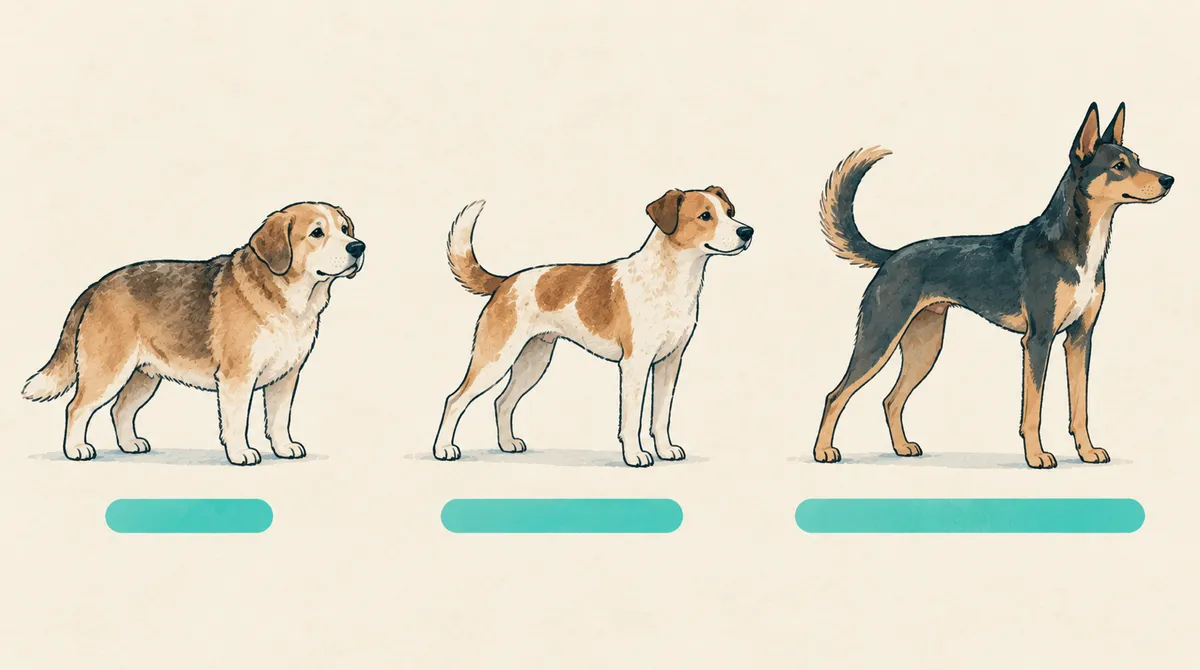
Figure 2 · A rough sense of scale
Three type sketches, not targets
The most useful reading is the dog's: a dog who comes home and settles is probably somewhere near enough; a dog still ricocheting off the furniture an hour later may need a different kind of output — and a dog who flags halfway may need less, or a vet visit.
Puppies and seniors: protect joints, keep it gentle
While a dog is still growing, PDSA advises introducing exercise slowly to protect developing joints — several short, gentle outings and free play rather than long hikes or repetitive fetch. The quick starts and sudden stops of thrown-toy games strain joints, so PDSA advises avoiding them for dogs that are still growing, elderly, injured, arthritic, overweight, or prone to joint problems.
At the other end of life, the guidance flips the order rather than the activity: PDSA's senior exercise advice (opens in a new tab) keeps exercise regular and gentle — little and often, shorter routes with rest stops, scent games and indoor sessions when the weather turns. Older dogs still need to get out every day to sniff and stretch; they just do it at their own pace, and the vet should hear about any change in mobility or enthusiasm.
Figure 3 · Both ends of life
Gentle at both ends, for different reasons
Still growing
Short, frequent, gentle exercise while joints develop. Build up slowly; skip sustained running, jumping, and repetitive fetch.
Senior years
Regular and gentle, little and often. Shorter familiar routes, rest stops, scent games, indoor options on extreme days.
Flat-faced and heavy dogs: watch effort, not just distance
Distance is a poor ruler for dogs whose bodies work harder. Flat-faced (brachycephalic) dogs can struggle to cool themselves and breathe hard sooner, so shorter outings in cooler parts of the day suit them better. Heavy dogs carry extra load on every joint, and PDSA's exercise guidance is direct about the next step: if you're unsure how much exercise your dog needs, or you're worried about their weight or fitness, ask your vet — a plan beats a guess.
For dogs who enjoy it, swimming earns a special mention in the same PDSA guidance because it exercises without pounding joints — with the usual water-safety checks, and a vet conversation first if joints are already a concern.
Signs a routine needs adjusting (and who to ask)
Adjust in both directions. Restlessness, chewing, and rough play indoors can signal a dog with unused energy — PDSA notes fit, active dogs are less likely to develop behaviour problems. In the other direction, lagging behind, lying down mid-walk, stiffness afterwards, or losing interest in going out suggest the routine is too hard for this dog right now.
Figure 4 · Vet questions, not training questions
Ease off and phone the vet if you notice
- Sudden reluctance to exercise in a dog who used to enjoy it
- Lameness, stiffness, or struggling to get around
- Breathlessness, heavy panting, or exhaustion out of proportion to the effort
- Any change in mobility — or in how much your senior dog enjoys exercise
PDSA's advice: if your dog stops enjoying exercise or starts struggling to get around, see your vet — there may be something they can ease.
Making walks count: sniffing is part of the walk
A walk is more than distance. PDSA splits them usefully: a brisk walk burns energy, while a slow, meandering sniffing walk does the mental work. Training minutes, play, and puzzle feeders all count toward a settled dog — though play doesn't replace the walk itself.
Match the outing to the weather as well as the dog — our weather and paw-care guide covers heat, cold and salted pavements. And if you're still learning to read whether the dog is enjoying themselves or just coping, the body-language guide shows what to watch. Photographing the dog at rest and mid-walk is an easy way to notice the difference — a photo observation describes what's visible in the frame, including the dog's build and activity — readings are AI-generated and provisional, so treat them as a prompt to look again, not a verdict.
A useful handoff: Start from the dog in front of you — their background, age, build, and how they finish a walk — and let the vet, not a chart, settle the questions that look like health.
Sources
- How much exercise does your dog need? (opens in a new tab) — PDSA: why breed, age, health, fitness and personality set the amount; daily walks; joint-strain cautions; when to ask the vet.
- Exercising your senior dog (opens in a new tab) — PDSA: regular, gentle, little-and-often exercise for older dogs; swimming and scent games; mobility changes go to the vet.
- The 7 AKC dog breed groups explained (opens in a new tab) — American Kennel Club: the original job behind each group and what it suggests about energy.
Sources last checked 2026-10-01.
Curious what a photo notices about your dog's build and activity? Dog Says Hi's photo observation lists the visible traits — the photo is sent only after you explicitly submit it, and the AI-generated reading is provisional and can be wrong or incomplete. For health concerns, contact a veterinarian.
Related reading
Exercise meets the weather, the breed groups, and the dog's own signals.
 Keep dogs comfortable through changing weatherHot pavements, cold paws, and the walks in between.
 The seven breed groups and everyday careWhat each group was bred for — and what it can't decide.
 Read dog body language in contextTired, engaged, or coping — the whole dog tells you.
- Everyday comfort for a senior dogLittle-and-often movement and home adjustments once age shows.
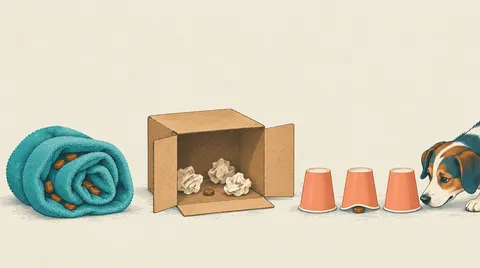 Rainy-day enrichment: indoor games that use the noseWhen the walk is short — sniff games, puzzles and quiet time.
Spotted an error? Tell us.