An everyday field guide
The seven breed groups — and what they hint at everyday care
A photo reading that says “sporting” or “herding” is borrowing a system built for something else: dog shows grouped breeds by the work they were developed to do. The history is real and sometimes useful — as long as you remember it describes a lineage's past, not your dog's needs.
Groups describe ancestry trends, not an individual dog's exercise, grooming, or temperament. Sources are linked beside each claim.
Published September 29, 2026 · Last updated September 29, 2026
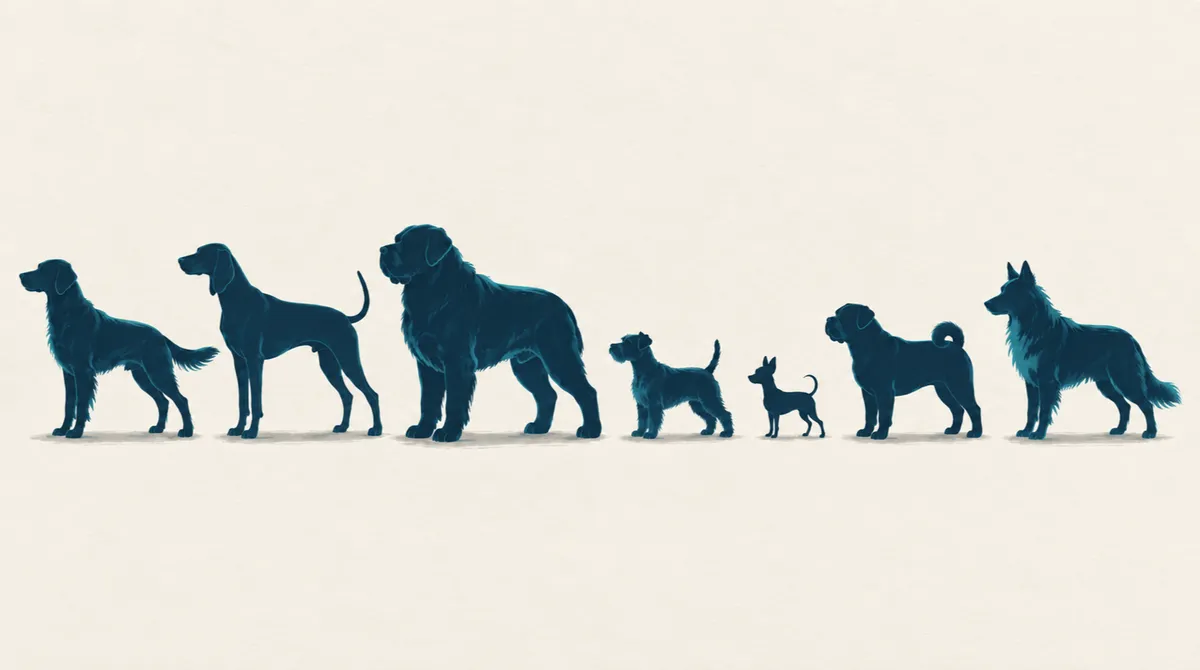
Why dogs were grouped at all
Breed groups began as show categories. Registries needed a way to judge similar dogs together, so they sorted breeds by the work each was originally developed to do — retrieving, hunting, guarding, herding, keeping laps warm. The American Kennel Club's seven-group explainer (opens in a new tab) lays out the system, and its breeds-by-group list (opens in a new tab) shows where each recognized breed sits.
That history makes the groups more meaningful than a random label — and less meaningful than people hope. A group describes the job a lineage was shaped for generations ago. It does not describe the dog asleep on your rug, whose needs depend on who they are, not only where they came from.
Sporting, hound and working: built for jobs
Sporting dogs were developed to find and retrieve game alongside hunters, often in water and cover. They tend to be built for sustained activity: athletic frames, coats that shrug off water, and an eagerness to work with a person. Retrievers and spaniels sit here.
Hound dogs were developed to chase — split into two very different styles. Scent hounds (beagles, bassets) trail with nose down and stamina up; sighthounds (greyhounds, whippets) run on sight with deep chests and long legs, built for short speed rather than distance.
Working dogs were developed for strength jobs: guarding, pulling, rescue. They are typically large and powerful — the group where build most visibly matches the original brief.
Terrier, toy, non-sporting and herding: varied shapes, shared histories
Terriers were developed to dig out vermin, which shows up as compact energy, wiry coats, and persistence. Toy dogs were bred small for companionship — their job was being near people. Herding dogs were developed to move livestock and notice movement, which is why so many remain attentive and quick to learn routines.
Non-sporting is the honest odd one out: the group that holds what did not fit elsewhere, from bulldogs to poodles. Two non-sporting dogs may share almost nothing in shape or history, so “non-sporting” tells you the least about everyday life.
Figure 1 · The seven groups at a glance
The original job, and a small everyday hint
What a group hint does and does not predict about one dog
A group label is a historical job description. It hints at tendencies you might see — a herding-shaped dog who notices every squirrel, a sporting-shaped dog who carries things in their mouth — but it cannot tell you what your dog needs today. PDSA's exercise guidance (opens in a new tab) is explicit that exercise needs vary with the individual dog's breed mix, age, health, fitness, and personality — not a group name.
Temperament varies just as much. Two dogs of the same breed can want opposite things, and a mixed-breed dog may carry the shape of one group and the disposition of none. Use a group hint as a hypothesis to test against your dog, never as a plan imposed on them.
Turning a group cue into small care choices
The useful question is narrower than “what does this group need”: it is “what small thing is worth trying, and what would tell me it landed?” A retriever-like coat might suggest trying water play and expecting shedding to brush out. Herding-shaped attentiveness might enjoy learning a routine or a game with direction. Scent-hound features might reward slow, sniffy walks over fast ones. A sighthound silhouette might settle into a sprint-then-sofa rhythm rather than long jogs.
Every one of those is a trial, not a rule — watch the dog you have, and let their enjoyment decide. The coat guide does the same for grooming, where texture beats group membership every time.
Figure 2 · A hint, not a plan
What a group cue suggests — and what it can't decide
A photo suggests a group — it never proves one
When a photo reading reports a group-like cue, it is describing a visible resemblance to a working shape — nothing more. The photo cannot see ancestry, and mixed ancestry blurs even the resemblance, as the shelter research in our breed-clues guide shows. Take the cue as a conversation starter about care, and let the dog in front of you close it.
A useful handoff: A group name is the lineage's résumé, not the dog's diary. Let the group suggest a small trial; let your dog decide whether it fits.
Sources
- The 7 AKC dog breed groups explained (opens in a new tab) — what each group was developed to do.
- AKC breeds by group (opens in a new tab) — which recognized breeds sit in each group.
- PDSA: how much exercise does your dog need (opens in a new tab) — why needs vary with the individual dog's breed mix, age, health, fitness, and personality.
Sources last checked 2026-09-29.
Got a photo reading with a group-like cue? Try Dog Says Hi's photo observation — the photo is sent only after you explicitly submit it — and treat each cue as a trial to test. For health concerns, contact a veterinarian.
Related reading
Where the group cues come from — and what they can and can't carry.
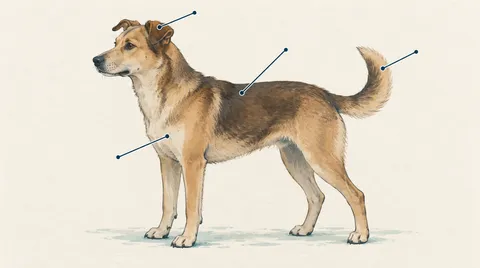 What breed might my dog be? Reading photo cluesWhich visible features hint at ancestry — and where guessing ends.
 Understand coat texture and routine groomingCare follows the coat you can feel, not the group name.
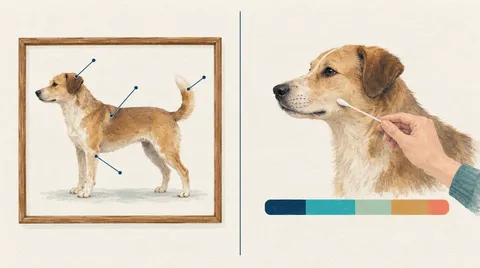 Photo guesses vs DNA testsWhat each method measures, and what neither can confirm.
Spotted an error? Tell us.