An everyday field guide
What breed might my dog be? Reading the clues a photo shows
You adopted a dog of unknown ancestry and the question follows you home. A photo can point toward breed influences — it can never certify them. This guide shows which visible clues carry weight, why mixes blur the picture, and where the honest answer ends.
Appearance can suggest breed influences; it cannot confirm ancestry, health, or temperament. Sources are linked beside each claim.
Published September 29, 2026 · Last updated September 29, 2026
Why “what breed is my dog” is hard to answer
Breed is a human label for a lineage kept consistent over generations. Registries such as the American Kennel Club sort recognized breeds into seven groups (opens in a new tab) based on the work they were developed to do. That system assumes you already know a dog's ancestry — usually because a breeder kept records. A rescue dog arrives without those records, so the question quietly becomes a different one: can appearance stand in for pedigree?
Only loosely. A photo captures how a dog looks in one moment, and looks are shaped by lighting, grooming, age, and body condition as much as by ancestry. A shaggy mixed-breed can photograph like a terrier; a purebred with a shaved coat can photograph like almost nothing familiar. The honest way to use a photo is to describe what is visible first, and treat any breed idea as a possibility — not a result.
Start with what is visible: coat, build, ears, tail
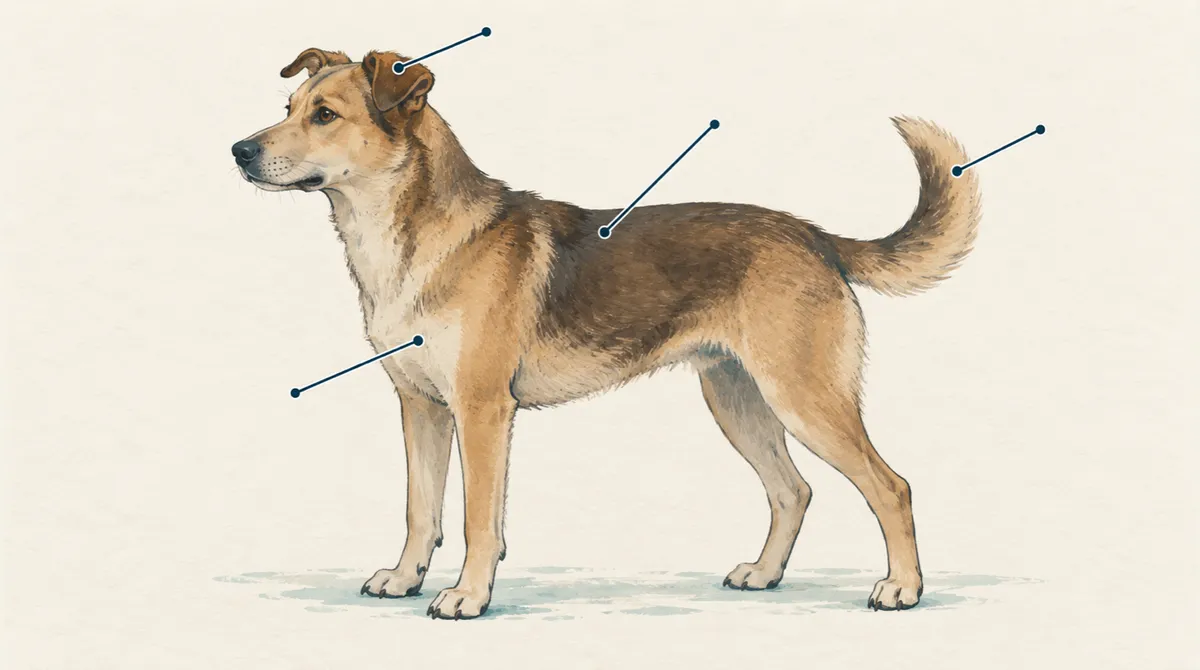
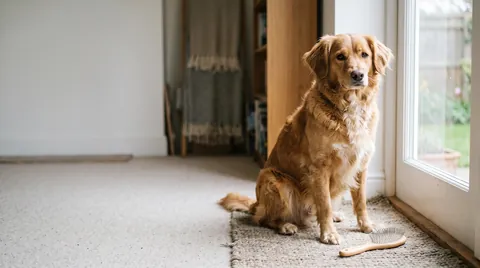
The most useful breed clues are the features you can describe without guessing: the coat's length, texture, and pattern; the ears' shape and set; the tail's carriage; the muzzle's proportions; the depth of the chest and the length of the legs. Write them down before naming any breed — the description stays accurate even when the guess changes. If you need the vocabulary, the coat colours and markings glossary defines the pattern words, and the coat types guide covers texture and grooming.
Figure 1 · Observation worksheet
Note these features before naming a breed
Which features hint at breed groups
Some visible features line up with the jobs certain breed groups were developed for. A dense, water-resistant coat and a thick, tapered tail once suited a dog retrieving from cold water — a sporting-group profile. A deep, narrow chest over long legs is the sighthound silhouette in the hound group. A compact, wiry frame with alert ears echoes the terrier shape. The AKC's breed list by group (opens in a new tab) shows which breeds carry these profiles, and the breed groups guide explains what each group was developed to do.
Treat these as hints, not matches. The same visible traits appear across many breeds and in dogs with no pedigree at all, because working shapes re-evolve wherever a job demands them. A pointed ear or a curled tail belongs to a long list of lineages — the feature narrows the conversation but does not close it.
Why mixes blur the picture (what shelter research found)
The clearest evidence comes from shelters, where visual labels get tested against genetics. In a PLOS One study of shelter dogs (opens in a new tab), staff breed labels were compared with DNA testing: the genetic results supported at least one labelled breed in 67.7% of dogs, but supported more than one labelled breed in only 10.4%. In plain terms, eyes usually caught part of the picture and missed the mixture — and the study measured shelter staff's labels, not a photo tool.
That is why a mixed dog can resemble a breed it barely shares. Each contributing lineage adds some features, and the visible sum can point somewhere none of the parts came from. When a photo seems to “scream” one breed, that impression is the photo doing its job of describing shape — not proving ancestry.
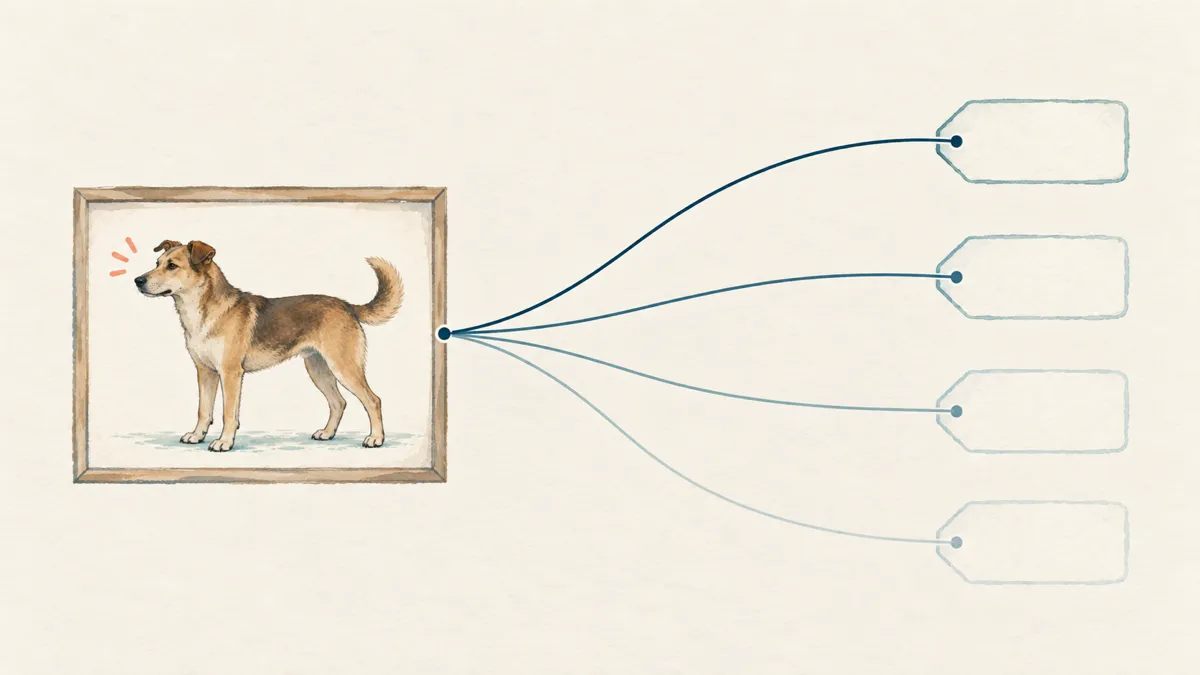
Figure 2 · How certainty fades
One photo, several possible cues
What a photo can never confirm
However convincing a picture looks, a photo cannot confirm breed or ancestry, and it cannot see health, emotion, temperament, or what a dog will be like to live with. It cannot confirm age beyond a rough impression, and it cannot certify that a dog is — or is not — a particular breed for paperwork purposes.
Even laboratories treat breed identity as a specialized question rather than a routine result. The UC Davis Veterinary Genetics Laboratory (opens in a new tab), for example, states that it does not offer a breed identification test; its canine services focus on inherited traits, health markers, parentage, and diversity instead. If ancestry matters that much to you, a consumer DNA test estimates it — with its own limits, covered in photo guesses vs DNA tests. And any health question belongs with a veterinarian, whatever the photo suggests.
How Dog Says Hi reads your photo
Dog Says Hi is built around this same order: it reports the visible traits in your photo first — coat, ears, build, markings, posture in the frame — and then lists possible breed cues, worded as possibilities rather than answers. Nothing in a result is a breed certificate, and a result that shows few cues is being honest, not broken.
When your result lists a possible cue like “retriever-like coat” or “herding build,” read it as a starting point for observation: does the visible feature really show, and what everyday care does that feature suggest? The breed-cue section is for curiosity and description; the visible-traits section is what you can act on. Try the photo observation and compare what it reports with what you see.
Care for the dog in front of you, whatever the breed
Most questions owners bring to the breed question are really care questions: how much exercise, what grooming, how big, how much attention. Those get better answers from the individual dog than from a label. Watch how your dog actually copes — energy across a day, coat through a season, comfort around handling — and let a vet weigh in on anything health-related. A good guess about ancestry is a pleasant extra; an accurate observation is what keeps a dog well.
A useful handoff: Describe the visible features first, treat every breed idea as a possibility, and let the dog's own behaviour and comfort settle the care questions.
Sources
- A canine identity crisis: genetic breed heritage testing of shelter dogs (opens in a new tab) — PLOS One (Gunter et al.), the shelter study behind the 67.7% and 10.4% figures.
- AKC breeds by group (opens in a new tab) — the American Kennel Club's recognized breeds organized by their original jobs.
- UC Davis Veterinary Genetics Laboratory FAQ (opens in a new tab) — notes that the lab does not offer a breed identification test.
Sources last checked 2026-09-29.
Want to see which visible traits a photo of your dog shows? Try Dog Says Hi's photo observation. The photo is sent only after you explicitly submit it. For health concerns, contact a veterinarian.
Related reading
Take the photo well, then decide how far the breed question needs to go.
 Take a dog photo that shows visible traitsMake a short, comfortable session and capture what is actually visible.
 Photo guesses vs DNA tests: what each can and can't tell youWhere a photo lookup ends and what a DNA test adds.
 Understand coat texture and routine groomingLength, texture, loose hair, and comfort with brushing.
Spotted an error? Tell us.