An everyday glossary
Dog ears, tails and muzzles: a visual glossary of feature shapes
Breed descriptions and photo readings are full of feature vocabulary — rose ear, sabre tail, stop, flews. This glossary explains the shape words in plain language, so a term becomes something you can look for on the dog in front of you rather than jargon you have to trust.
These terms describe shape only. An ear set or tail carriage says nothing certain about breed, health or temperament on its own.
Published October 1, 2026 · Last updated October 1, 2026
How to use this glossary
Find the word, read the plain meaning, then check it against the dog — a definition only earns its place if it matches something you can see. These terms come from breed-club vocabulary, so the reference this page follows is the AKC's official glossary (opens in a new tab), which collects the words breed standards are written in.
A caution that applies to every definition here: a feature word describes a shape. It does not confirm a breed, and on a mixed dog it describes that dog's ears or tail, not an inheritance you can count. Shape words are the observation; the name you put on the dog comes later, if at all.
Ear sets: prick, drop, rose, bat, button, semi-pricked
Ear words describe two things at once: whether the ear stands or folds, and where it sits on the head — the "set". Photo captions and breed descriptions lean on these six shapes most.
- prick ear
- An erect, pointed ear that stands up and away from the head — the upright triangle familiar from shepherd-type dogs.
- drop ear
- The ear leather folds over and hangs rather than standing; the classic spaniel or hound ear.
- rose ear
- A small drop ear that folds over and back, revealing the inner ear — the neat rose shape seen on sighthounds.
- bat ear
- An upright ear with a broad base and a rounded top, the opening facing forward — proportionally large, as on a French Bulldog.
- button ear
- A small, neat ear whose flap folds forward to cover the ear opening — the tidy fold of many terriers.
- semi-pricked
- Erect at the base with the tip folding forward — halfway between a prick ear and a button fold; the collie's familiar tip-over.
Two more ear words you may meet in a description: cropped — ear leather trimmed surgically to encourage the ear to stand — and flying ears, the glossary's term for drop or semi-prick ears that lift while the dog moves. Ear position changes constantly with attention and mood, so name the resting shape, not the alert one.
Tails: sickle, curled, sabre, straight — and what carriage adds
Tail words split into two kinds: the shape of the tail itself, and the carriage — how it is held, which is half of what a photo freezes. The glossary's tail set adds a third: how the base sits on the rump, high or low, before carriage even begins.
- sabre tail
- Carried in a semicircle — the gentle upward curve the word suggests. "Sickle" is used loosely for much the same sweep.
- ring tail / curled
- Carried up and around almost in a circle — the full curl of many spitz-type dogs.
- whip tail / straight
- Carried out stiffly straight and pointed — the pointer's working flag.
- otter tail
- Thick at the root, round and tapering, with the hair parted underneath — the Labrador's rudder.
- screw tail
- Naturally short and twisted in a spiral formation — the fixed corkscrew of breeds like the Bulldog.
- gay tail
- Carried above the horizontal level of the back — upright without necessarily curling.
- flag
- A long tail carried high with feathering on the underside — the setter's display.
- brush
- A bushy tail heavy with hair — shape rather than carriage.
- bobtail / docked
- Born without a tail, or with a tail docked very short — worth noting because a bobbed tail changes what "carriage" can mean in a photo.
Carriage words travel with posture: the glossary describes a tail circling over the back as "making a wheel", and the same tail can sit differently when the dog is relaxed, focused or cold. Read the resting carriage in a calm photo before you read anything into the alert one.
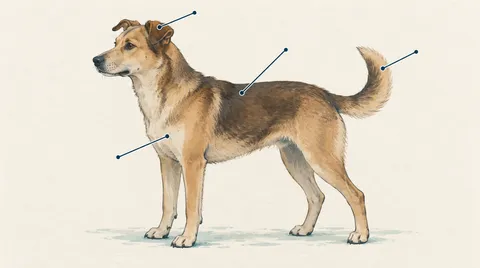
Figure 1 · Three tail questions
Shape, set and carriage read separately
Muzzle and head: stop, flews, snipy and the two skull directions
Head vocabulary splits into the foreface — the part of the head before the eyes — and the topskull behind it. These are the terms photo readings and breed descriptions reach for.
- stop
- The step where the skull meets the muzzle — shallow and sloping on a collie, deep and abrupt on a pug.
- flews
- The pendulous parts of the upper lip, particularly at the inner corners — the hang you see on hounds and mastiffs. "Chops" and "jowls" name the same pendulous flesh of the lips and jaw.
- snipy
- A pointed, weak-looking muzzle lacking breadth and depth — usually a criticism in a breed standard, not a compliment.
- down-faced
- A muzzle inclining downwards from the skull to the tip of the nose — the downward plane seen in some bull-type profiles.
- dish-faced
- A slight concaveness of the foreface in profile — the middle of the muzzle sitting lower than its ends.
- apple head / domed
- A round-shaped skull — apple head for the pronounced roundness, domed for an evenly curved topskull.
- occiput
- The back point of the skull — the bump you can feel at the rear of the head on some dogs.
Two broader words describe the direction the whole skull takes. A brachycephalic head is short and broad — the flat-faced pattern of pugs, bulldogs and boxers. A dolichocephalic head is long and narrow — the greyhound direction. Neither is a glossary entry or a breed label; they are the shape words vets use, and they matter for one practical reason: very short-muzzled dogs can work harder to breathe, especially in heat or under exertion — the exercise guide's flat-faced section covers pacing effort, and anything beyond everyday comfort is a vet conversation.
Why feature words help — and where they mislead
Feature vocabulary earns its keep as description: "a button-eared, ring-tailed dog" tells a groomer, a vet or a rescue something a guessed breed label can't. It misleads the moment it is asked to carry more. The same word shifts slightly between breed standards — the AKC's breeds-by-group pages (opens in a new tab) organise over two hundred breeds whose standards each bend these shared terms — photographs freeze one moment of a moving ear or tail, and mixed dogs combine features without following any single description.
Figure 2 · Describing before naming
A simple order for describing features
Feature words also travel with a caveat the glossary keeps quietly: some entries describe the result of cropping or docking — surgical alterations that change an ear's set or a tail's length. Words like these describe what is visible; they say nothing about whether a feature came by birth or by procedure, and nothing at all about health or temperament. For the texture-and-colour half of the same vocabulary, the coat and markings glossary covers the words a coat carries.
A useful handoff: Ears, tail, head — three zones of description are worth more than one confident guess at a breed.
Sources
- AKC glossary (opens in a new tab) — the breed-club vocabulary this page follows for ear, tail and head terms.
- AKC breeds by group (opens in a new tab) — how the shared feature vocabulary is organised across more than two hundred breed standards.
Sources last checked 2026-10-01.
Reading a description that uses these words — or a photo result that does? Dog Says Hi's photo observation describes visible traits like ear set and muzzle shape; the photo is sent only after you explicitly submit it, and the AI-generated reading is provisional and can be wrong or incomplete. For concerns about a dog's structure or comfort, contact a veterinarian.
Related reading
Feature words sit beside coat words — and under the breed guesses they feed.
 Dog coat colours and markings glossaryThe colour and pattern half of the same vocabulary.
 What breed might my dog be? Reading photo cluesHow these features feed — and limit — a breed guess.
 Understand coat texture and routine groomingCare follows texture and the dog, not the feature names.
Spotted an error? Tell us.