An everyday field guide
Body-language myths: wagging tails, 'guilty looks' and 'alpha' ideas
Some dog rules of thumb are so repeated they feel like fact: wagging means happy, the sheepish face means the dog knows, and half of dog training is about rank. All three are more interesting — and more useful — once checked against the evidence.
This guide corrects interpretation habits, not behaviour problems — persistent fear or aggression is a vet or qualified behaviourist question. Sources are linked beside each claim.
Published October 1, 2026 · Last updated October 1, 2026
Why simple rules about dog behaviour spread
Dog myths travel well because they're simple, confident and memorable — a wag equals happy, a lowered head equals guilt, a pushy dog equals a bid for rank. Single-signal readings are easy to repeat, and they flatter our wish to know what a dog is feeling at a glance.
The accurate version is less tidy: body language is read as a whole, in context. PDSA's body-language guidance (opens in a new tab) puts it plainly — look at the dog as a whole, not one sign, and weigh the situation the dog is in. The myths below all fail the same way: they take one movement, freeze it, and hand it a meaning it can't carry alone.
'Wagging means happy' — what the tail actually says
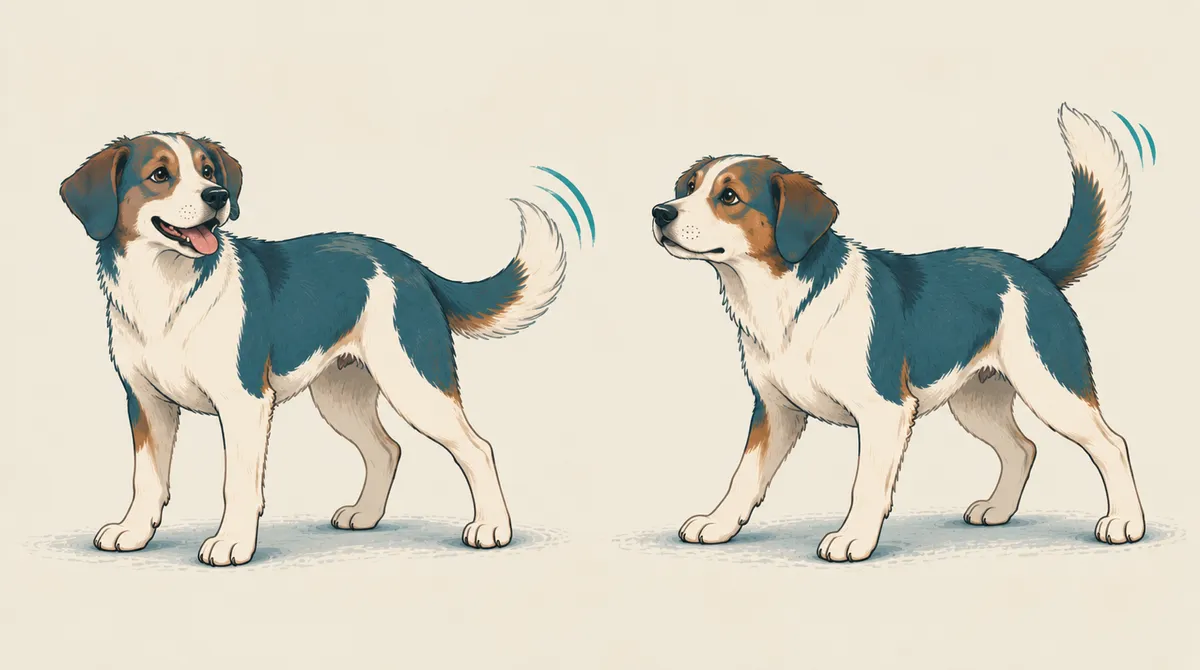
A wag is motion, not a verdict. PDSA's guidance says it directly: a wagging tail doesn't always mean a happy dog. Loose, high, wiggly wags paired with a relaxed body are the familiar picture of pleasure — but low or slow wags can accompany fear or insecurity, and a stiff, straight tail that seems to shake rather than wag belongs to a very different, more serious posture.
Figure 1 · The tail plus everything else
Same wag, different dog
Tail shape itself adds noise: a naturally curled tail, a very short tail, or a tail that can't be seen clearly in a photo all change what the signal looks like. Which is why the rule isn't "ignore the tail" — it's "don't let the tail vote alone".
The 'guilty look': what research suggests
The scene is universal: a chewed shoe, a lowered head, a dog that looks, to human eyes, sorry. The most cited test of this is Alexandra Horowitz's 2009 study, published in Behavioural Processes (opens in a new tab). Owners told their dogs not to eat a treat, then left the room; the researchers varied both what the dogs did and what owners were told. The result: the "guilty look" tracked the owner's behaviour, not the dog's deed. Dogs scolded by their owners showed more of the look regardless of what they'd done — and dogs that had obeyed but were scolded anyway looked the "guiltiest" of all.
The better reading is simpler and sadder: the look is appeasement — a response to your expression, tone and posture right now, assembled from the same family of signals PDSA lists for stress: lowered body, tucked tail, lip licks, averted eyes. That has a practical edge. Scolding a "guilty" dog after the fact doesn't address what happened; it punishes the dog for reading your mood. Management works better — put the shoes away, fix the routine — and if chewing, soiling or destruction is new or persistent, that's a reason for a vet check first, because behaviour changes can have physical causes.
'Alpha' and dominance: why the idea persists and what replaced it
The dominance story — dogs as perpetual rank-seekers, owners as alphas who must win — is the most organised of the myths, and the one professional behaviourists have worked hardest to retire. The American Veterinary Society of Animal Behavior's position statements (opens in a new tab) make the core correction: dominance describes a relationship between individual animals — who yields to whom — not a personality trait a dog carries around, and applying rank theory to ordinary household behaviour misreads what dogs are doing.
The harm isn't just conceptual. AVSAB's statement warns that dominance framing pushes people toward force and confrontation, and that punishment can suppress aggression's warning signs without addressing its causes — fear and anxiety being common ones. A dog taught not to growl hasn't been reassured; it's been disarmed of its alarm. The guidance that replaced the mythology is less cinematic and more effective: AVSAB's humane-training position recommends reward-based methods and advises against aversive techniques, which is also where PDSA's stress guidance lands — reward what you want rather than punishing what you don't.
None of this means dogs never guard food, barge through doors or push boundaries — they do. It means the explanation that helps is usually about learning, fear, pain or opportunity, not a campaign for household leadership. The framing matters because it decides the response: a "dominant" dog gets confronted; a worried or opportunistic dog gets understood.
One signal is never the whole story
Each myth above fails by isolating one behaviour. The corrective habit is to read combinations — the same dog can shake off after a bath (a normal wet-dog response) or after a tense encounter (a self-calming behaviour PDSA notes lowers heart rate); only the situation tells you which you're watching.
Figure 2 · The questions to run
Instead of a single signal, ask
Where to look instead: posture, context, change
The better habit is unglamorous: watch the whole dog, note what just happened, and treat change as the loudest signal — a dog acting differently to its normal self is worth more attention than any single posture. For meetings with unfamiliar dogs, the greeting guide turns the same whole-dog reading into a polite routine.
And when behaviour worries rather than puzzles, the order is settled: vet first, because pain and illness change behaviour (PDSA sends sudden behaviour changes to the vet for a check-up), then a qualified, reward-based behaviourist — PDSA notes vets can refer to approved trainers and certified behaviourists. The myths all offered shortcuts. Reading the actual dog takes a little longer, and it works.
Sources
- Position statements (opens in a new tab) — American Veterinary Society of Animal Behavior: dominance as a relationship descriptor rather than a trait, the risks of confrontation-based methods, and the recommendation of reward-based training.
- Disambiguating the "guilty look" (opens in a new tab) — Horowitz, Behavioural Processes (2009): dogs showed "guilty look" behaviours when scolded, not when guilty — obedient dogs scolded by misinformed owners showed the most.
- How to tell if your dog is happy (opens in a new tab) — PDSA: wagging tails don't always mean happy; read the whole dog and the situation.
- Tips to identify and prevent stress in dogs (opens in a new tab) — PDSA: the subtle stress signals, reward-based responses over punishment, and the vet-referral route for behaviour concerns.
Sources last checked 2026-10-01.
This is also why a photo can't tell you what a dog feels. A Dog Says Hi photo observation describes visible traits and posture rather than assigning a mood — the photo is sent only after you explicitly submit it, and the AI-generated reading is provisional and can be wrong or incomplete. For fear, aggression or behaviour that worries you, contact a veterinarian first.
Related reading
Myth-checking sits beside the full body-language read and the everyday routines it supports.
 Read dog body language in contextThe full signal set — posture, face, tail and surroundings.
 Meeting dogs politelyReading these signals in real time, with children watching.
 Introduce dogs at their paceDog-to-dog greetings — where the same signals run both ways.
Spotted an error? Tell us.