An everyday field guide
Helping a rescue dog settle in: the first weeks
The dog you brought home may be quieter, flatter or more watchful than the dog you met — and that is usually the work beginning, not going wrong. This guide covers what settling actually looks like, the shape the early weeks often take, and the moments that deserve professional help rather than patience.
Persistent fear, aggression, or anything that looks like a health worry is a vet or qualified behaviourist question — no guide can timetable a dog's trust.
Published October 1, 2026 · Last updated October 1, 2026
What 'settling' actually looks like
Settling rarely looks like instant happiness. In the first days it often looks like the opposite: a dog who is shut down, sleeping a great deal, barely eating, watching from a distance, or glued to one spot. The Dogs Trust settling guide (opens in a new tab) describes the arc as gradual — dogs may need weeks to months to relax — and the early version of "settled" is simply a dog who can rest, eat, and explore a little without fear.
The useful early signs are small: choosing to come out of their safe space, sniffing around a room, accepting a treat, lying with a relaxed body rather than a frozen one. Equally, a dog who is confident on day one can be decompressing too — some rescues show behaviour only after the first weeks, when the environment stops feeling temporary. Quiet is not a personality verdict in either direction; it is a starting point to observe from.
The 3-3-3 idea — a useful shape, not a promise
Many adopters meet a popular shorthand: three days for a dog to decompress, three weeks to learn the routine, three months to feel at home. Treat it as a shape, not a schedule. It usefully says that settling is slower than a weekend — but no rule can promise a timeline for an individual dog, and plenty of healthy rescues take longer on one leg and shorter on another.
What the sources agree on is the underlying pattern, whatever the numbers: things change gradually, progress is uneven, and patience is part of the plan rather than a delay to it. If the "rule" helps you leave a hidey dog alone without worry, it has done its job; if it has you counting days and fretting, put it down.
A quiet base: one space that is theirs
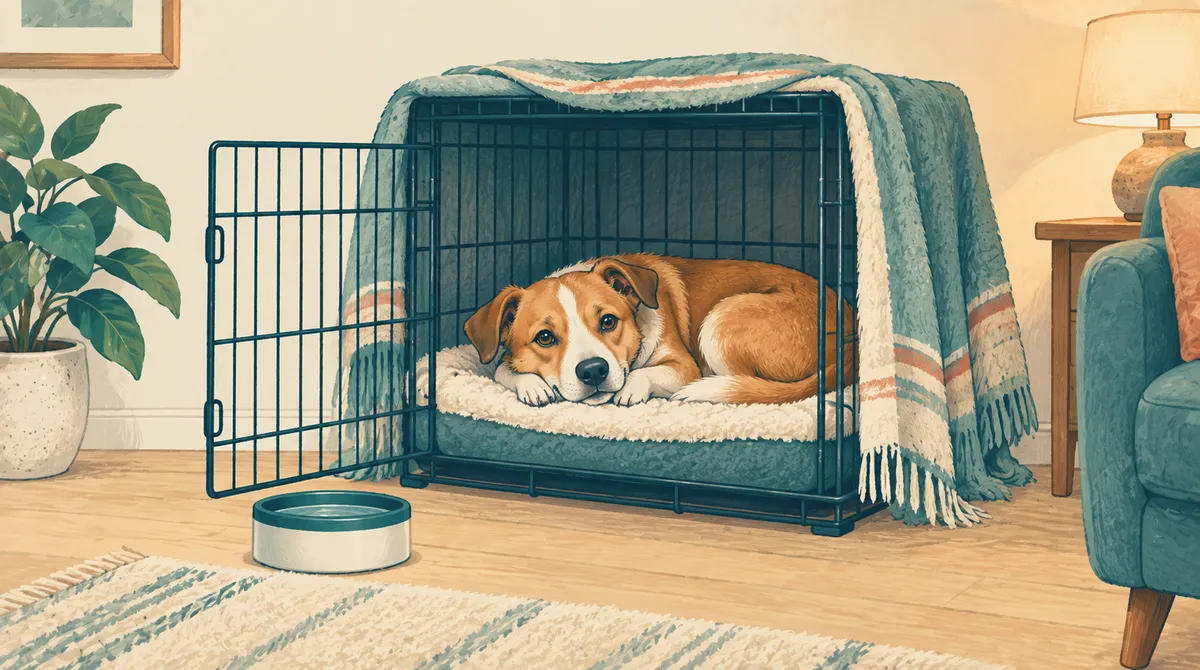
Dogs Trust's guide puts a den-like space at the centre of settling — a quiet corner with a bed or an open, partly covered crate, away from the busiest routes through the home, where the dog can retreat and not be disturbed. Nobody reaches in, children included; the space works because it is entirely the dog's.
Around that base, the first rooms should be small and predictable. Some dogs need a few days living mainly around their safe space before the house opens up; the dog's own curiosity is the door-opening signal. Food-toy enrichment — a stuffed Kong or a snuffle mat — can fill quiet time without social pressure.
Figure 1 · The safe base
What makes a corner a den
Routine before adventures
Adopted dogs arrive without knowing how anything works here — where food appears, where they toilet, when the house goes quiet. A predictable daily rhythm is the fastest kindness: the same feeding times, the same toilet trips, the same sleeping place, roughly the same household hours. Dogs Trust's guidance is consistent on this — keep the routine steady and let new experiences wait until the ordinary is familiar.
That means resisting the urge to show the dog the world in week one. Keep interactions calm and brief, let the dog choose whether to approach, and don't force attention — the Dogs Trust guide is explicit that a settling dog should not be pressured into contact. A short diary helps here: a line a day on eating, sleeping, exploring and greeting makes slow progress visible when the day-to-day feels static.
Figure 2 · The settling week
Small, predictable, repeatable
- Same anchor pointsFood, toilet trips and sleep happen at the same times in the same places.
- Short, calm contactLet the dog approach; a few strokes, then pause and let them choose more.
- One quiet outingShort local walks rather than new busy places — same route is a feature.
- Note it downOne line a day — eating, resting, exploring — makes gradual change visible.
Visitors, other pets and first walks
The rescue-dog cliché — everyone wants to meet the new arrival — is worth resisting for the first days. Dogs Trust advises keeping visitors away while the dog settles, and making any later introductions calm and brief. When visitors do come, the dog watches from a comfortable distance first and chooses whether to approach; a visitor who ignores the dog is more help than one who greets them.
Resident pets follow the same gradual pattern: a scent and sight introduction, short supervised meetings, and separation when unsupervised, until both animals are relaxed — the introductions guide covers dog-to-dog meetings step by step. First walks stay short and local, and some rescues benefit from days of garden time before street walks begin — the pace is set by the dog's comfort, not the calendar.
Setbacks that are normal — and signs to get help
Settling is not linear. A dog who was eating may skip a meal after a startling noise; a dog approaching hands may retreat after a long visitor afternoon. PDSA's guidance on fearful dogs (opens in a new tab) describes the stress signals to watch in everyday situations — freezing, turning away, lip licking, cowering, stiffening — and notes that rebuilding confidence can take months, not days.
Most of that is the normal weather of settling. The points that change the route are different in kind: fear or aggression that persists or worsens, a dog who cannot be approached or handled at all after weeks, or anything that could be illness rather than behaviour. Dogs Trust's guidance on stressed dogs (opens in a new tab) puts the vet first — a behaviour change can have a medical cause even without obvious signs, so the vet rules that out and can refer on to a qualified behaviourist. AVSAB's position statements (opens in a new tab) add the method question: humane, reward-based approaches over dominance-based ones. And the rule that protects progress is simple: never force an interaction — distance first, then gradual positive exposure.
Figure 3 · When the route changes
Take these to a professional
- Fear or hiding that is not easing across weeks, or is getting worse
- Aggression — growling, snapping or biting at people or pets
- Anything that could be health rather than behaviour — appetite, pain, sudden change
- Feeling unsafe in your own home, or worried about a bite
Vet first for anything that could be health, then a qualified behaviourist — ask your vet for a referral, and look for reward-based methods.
A useful handoff: A quiet base, a predictable day, unforced contact — and the patience to let the dog write the timetable.
Sources
- How to help a rescue dog get settled into your home (opens in a new tab) — Dogs Trust: the safe space, the steady routine, unforced contact, and gradual introductions.
- Helping a fearful dog feel safer around other dogs (opens in a new tab) — PDSA: recognising stress signals, never forcing interaction, and the gradual exposure approach.
- Why dogs get scared or frustrated and how to help them (opens in a new tab) — Dogs Trust: the stress-sign vocabulary, and the vet-first route for behaviour change that could be medical, with referral on to a qualified behaviourist.
- AVSAB position statements (opens in a new tab) — the American Veterinary Society of Animal Behavior's recommendations, including humane, reward-based training methods.
Sources last checked 2026-10-01.
Settled enough to stand for a photo? A Dog Says Hi photo observation can help you notice coat condition and visible traits as the dog relaxes — the photo is sent only after you explicitly submit it, and the AI-generated reading is provisional: it cannot measure trust, temperament, or how the dog feels. For behaviour worries or anything that looks like illness, contact a veterinarian.
Related reading
Settling sits between the first-week checklist and the slower work of reading the dog.
 New dog? A calm first-week checklistThe practical setup this settling arc sits inside.
 Read dog body language in contextThe stress and comfort signals this guide asks you to watch.
 Meeting a dog before you adoptThe shelter-visit checklist that comes before the first weeks.
Spotted an error? Tell us.