An everyday field guide
Introduce dogs at their pace
A good first meeting can be brief. The goal is to let both dogs stay comfortable enough to make a choice about distance. No breed guess, coat type, or photograph can tell you whether two dogs will become friends.
A photograph cannot tell you whether two dogs will get along. Sources are linked beside each claim.
Begin with room to move
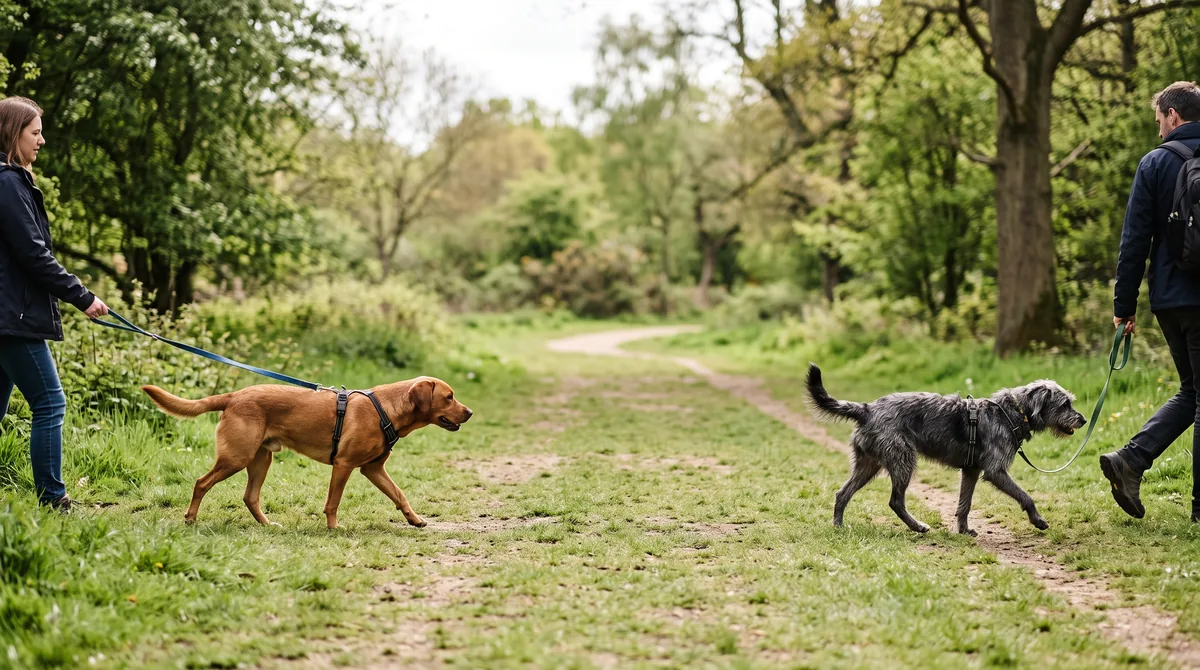
For two dogs, PDSA recommends a quiet neutral place, a handler for each dog, and space between them at first. Watch both dogs' whole-body signals. Move closer only while both remain comfortable; don't pull them together or insist on a nose-to-nose greeting. A calm parallel walk may be more useful than a long face-to-face pause.
Figure 1 · A first meeting
Two parallel lanes, room between
Shorten the distance only while both dogs stay comfortable. Don't pull them together or insist on a nose-to-nose greeting.
If either dog stiffens, withdraws, growls, or repeatedly struggles to stay relaxed, stop and make space. A growl is information, not something to punish. PDSA's communication guide explains why respecting the signal matters. Try again later only if the situation can be made calmer; persistent difficulty deserves support from a veterinarian or qualified behavior professional.
Let a short greeting be enough
PDSA's introduction guidance describes short greetings and repeated calm walks. There is no fixed timetable. Some dogs may prefer more distance around others, and that can be a valid way for them to feel safe. PDSA's fearful-dog guidance cautions against assuming every dog needs a dog friend.
Puppies may need a different location while vaccinations are incomplete. A controlled garden or low-dog-traffic setting can be more suitable than a public meeting place; ask a veterinarian what is appropriate for the individual puppy. Blue Cross and PDSA discuss the vaccination constraint.
Set up the home before sharing it
When a meeting progresses to a home, supervise closely. Give each dog a separate resting place, feed them separately, and remove valued toys at first. PDSA's introduction guide supports these simple preparations. Continue to watch both dogs and make room for them to disengage. Successful introductions may need several calm sessions; friendship is not a guaranteed outcome.
Figure 2 · Home plan
Separate spaces before sharing
A useful handoff: Plan the setting, handlers, distance, and exit before a meeting. Notice what each dog does over time. A still image cannot show compatibility or replace a qualified professional's help with a persistent concern.
To learn more about observation without assigning an emotion, read the body-language guide.
Related reading
Reading both dogs' signals makes each stage of an introduction easier to judge.
 Read dog body language in contextNotice the whole dog before drawing a conclusion.
 Keep dogs comfortable through changing weatherWarm-weather planning and winter paw care.