An everyday explainer
Puppy socialisation: why the early weeks matter
New puppy owners get two pieces of advice that seem to argue with each other: protect the puppy from disease, and show it the world early. Both are real — this guide covers why the early weeks carry so much weight, how to socialise safely while vaccination is still underway, and why a missed window is a slower path, not a closed door.
Vaccination timing is your vet's decision, not this guide's. Fear or aggression that persists deserves a vet or qualified behaviourist.
Published October 1, 2026 · Last updated October 1, 2026
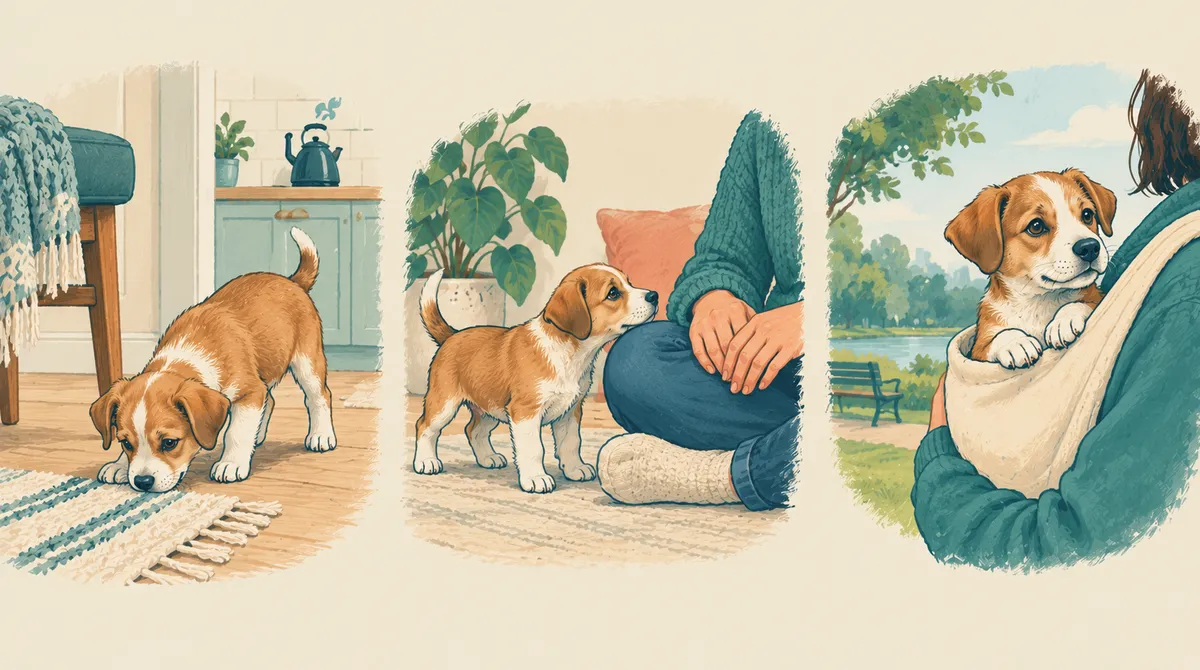
The early window: why weeks 3–12 matter
Puppies pass through a developmental period when new experiences register as normal rather than threatening. The American Veterinary Society of Animal Behavior's puppy socialization position statement (opens in a new tab) names the first three months of life as the primary and most important window — roughly weeks 3 to 12 — while the Dogs Trust puppy guide (opens in a new tab) describes the vital window as the first four months. The sources differ in the exact edge, not the idea: the early weeks are when "normal life" is written.
The reason it matters is durable: experiences — people, dogs, surfaces, sounds, handling — filed as safe in this period tend to stay safe in the adult dog. AVSAB's statement puts the stakes plainly: behavioural problems, not infectious disease, are described as the leading cause of death in dogs under three, which is why it treats early socialisation as a welfare issue rather than a nicety. That does not make the window a deadline panic — it makes it an early start.
Figure 1 · The window, roughly
What the early weeks are for
What 'socialisation' really means (and what it isn't)
Socialisation is not "playing with other dogs". It is the whole catalogue of ordinary life: different people of different ages and shapes, other animals, traffic, household appliances, being handled, car journeys, different floor surfaces, being alone briefly. Dogs Trust's guidance describes it as teaching the puppy that the everyday world is normal — introductions that are gradual, controlled, and made while the puppy is relaxed.
Equally important is what it is not. It is not flooding the puppy with everything at once, not forcing greetings, and not a test of toughness. A frightening first meeting can teach the opposite lesson — a scary thing happened and it was called socialisation. Each new experience should be small enough that the puppy can watch it, sniff it, and choose it — with the option to retreat a step when it's too much.
Safe exposure before vaccination is complete
This is where the two pieces of advice meet — and where guidance differs in detail. AVSAB's position is that socialisation should begin before the vaccination series is complete, because the behavioural risk of waiting outweighs the disease risk of controlled exposure. Dogs Trust's UK-facing guidance is more conservative about ground contact — puppies shouldn't walk in public places before they are fully vaccinated — but it solves the same problem: the puppy sees the world carried in arms or a carrier, meets vaccinated dogs at home, and explores an enclosed garden that unknown dogs don't use.
Read those together and the shared principle is clear: control the risk, don't cancel the exposure. Carrying the puppy to hear traffic and watch people, inviting vaccinated known dogs to visit, playing household sounds at low volume, handling paws and ears gently — all of it counts, and all of it can happen before the vaccination course finishes. Where the line sits for public ground in your area is a vet question — vaccination timing and local disease risk are genuinely theirs to call, and PDSA's new-puppy Q&A (opens in a new tab) puts the schedule squarely with the vet who knows the puppy.
Figure 2 · Low-risk, high-value
Exposure that works before full vaccination
- Carried outingsArms or a carrier to see streets, traffic and people — no ground contact needed.
- Home visitorsCalm people of different ages, looks and voices, at the puppy's pace.
- Known vaccinated dogsFriends' healthy dogs indoors or in a clean enclosed garden.
- Sounds and surfacesHoover, television, doorbell; carpet, tile, grass, wet pavement in safe places.
- Gentle handlingPaws, ears, mouth and collar touched kindly — grooming and vet visits get easier.
- Short solo momentsBrief alone-time builds the tolerance that prevents separation panic later.
Puppy classes and calm first meetings
A good puppy class is the managed version of socialisation: small numbers, health prerequisites, and meetings at a scale a young dog can handle. AVSAB's statement supports classes from around seven to eight weeks — but attaches conditions: the puppy should have had at least one set of vaccines at least seven days before the first class, plus a first deworming, and should stay current on vaccines and parasite control through the course. Whether a given puppy meets that standard on a given schedule is a vet question — confirm with yours before booking. Within those limits, the emphasis stays on positive reinforcement and varied, safe experiences rather than free-for-all play.
For one-to-one meetings, the mechanics mirror the adult version in miniature: let the puppy watch a calm, vaccinated dog at a distance first, close the gap slowly, keep the meeting short, and end while it is still going well. The introductions guide covers dog-to-dog meetings step by step. Choose class and playmates for calm and health, not novelty — the risk AVSAB warns against is the uncontrolled kind: high-traffic dog areas with unknown dogs before vaccination is complete.
Signs a puppy is overwhelmed
The difference between learning and flooding is the puppy's body. A puppy meeting something new at a workable dose is curious: sniffing, loose body, approach-withdrawal bounces. Overwhelmed looks different — and it's the signal to add distance, not push through:
Figure 3 · Too much, too fast
Back off when you see these
- Freezing, cowering, or hiding behind you or furniture
- Tail tucked, body low, repeatedly trying to leave
- Barking, lunging or frantic struggling to escape
- Not taking treats they'd normally take
Flooding doesn't socialise — it teaches fear. Add distance, let the puppy watch from where they cope, and try again smaller another day.
Persistent fearfulness is different in kind from one big day. A puppy who can't recover between encounters, or who is frightened of ordinary things week after week, is a case for the vet and a qualified behaviourist — early help is what the behavioural-vet position papers are for.
Missed the window? It is not too late to help
An older puppy or a rescue who missed the early weeks is not broken — the window narrows, it doesn't close. The same principles apply at a slower gear: calm, controlled exposure; positive associations; distance before approach; and professional help sooner rather than later if fear runs deep. PDSA's fearful-dog Q&A (opens in a new tab) describes the same gradual, reward-based approach working past puppyhood — it just asks more patience.
And if you're early rather than late: the settling work comes first. A brand-new puppy benefits from a quiet base and routine before the social calendar fills — the rescue settling guide covers that arc for older dogs, and the first-week checklist covers any new arrival's opening days.
A useful handoff: Early, small, positive, controlled — socialisation is exposure at the puppy's pace, with your vet deciding the vaccination calendar underneath it.
Sources
- Puppy socialization position statement (opens in a new tab) — American Veterinary Society of Animal Behavior: the first-three-months window, and socialisation before full vaccination as the recommended approach.
- Introducing your puppy to the world around them (opens in a new tab) — Dogs Trust: the vital early window, gradual and controlled introductions, and carried outings before full vaccination.
- Common questions from new puppy owners (opens in a new tab) — PDSA: registering with a vet early, and vaccination timing as the vet's call.
Sources last checked 2026-10-01.
Watching a puppy change week to week? A Dog Says Hi photo observation can describe the visible traits — coat, proportions, ear set — as they grow; the photo is sent only after you explicitly submit it, and the AI-generated reading is provisional and can be wrong or incomplete. It can't assess age, health or temperament. For vaccination timing or behaviour worries, contact a veterinarian.
Related reading
Socialisation sits between the first-week setup and the first dog meetings.
 New dog? A calm first-week checklistThe quiet setup the socialisation weeks build on.
 Introduce dogs at their paceThe mechanics of first dog-to-dog meetings.
 Read dog body language in contextThe stress signals that tell you to add distance.
Spotted an error? Tell us.