An everyday field guide
New dog? A calm first-week checklist
The first week with a new dog is less about doing everything right and more about doing a few things calmly. This checklist keeps the days small: one prepared space, a predictable rhythm, the paperwork that keeps a dog findable, and the phone number of the vet who will come to know them.
This is a setup checklist, not medical care. Vaccination, microchip and health schedules belong with the vet who will know your dog.
Published October 1, 2026 · Last updated October 1, 2026
Before the dog arrives: space, supplies, a vet practice
Pick one room or corner as the dog's whole world for the first day or two — somewhere quiet, easy to clean, and closable with a door or gate. The AKC's first-day-at-home guidance (opens in a new tab) advises limiting a new dog's access and opening up the house one room at a time rather than giving the full tour at once. Everything else can wait.
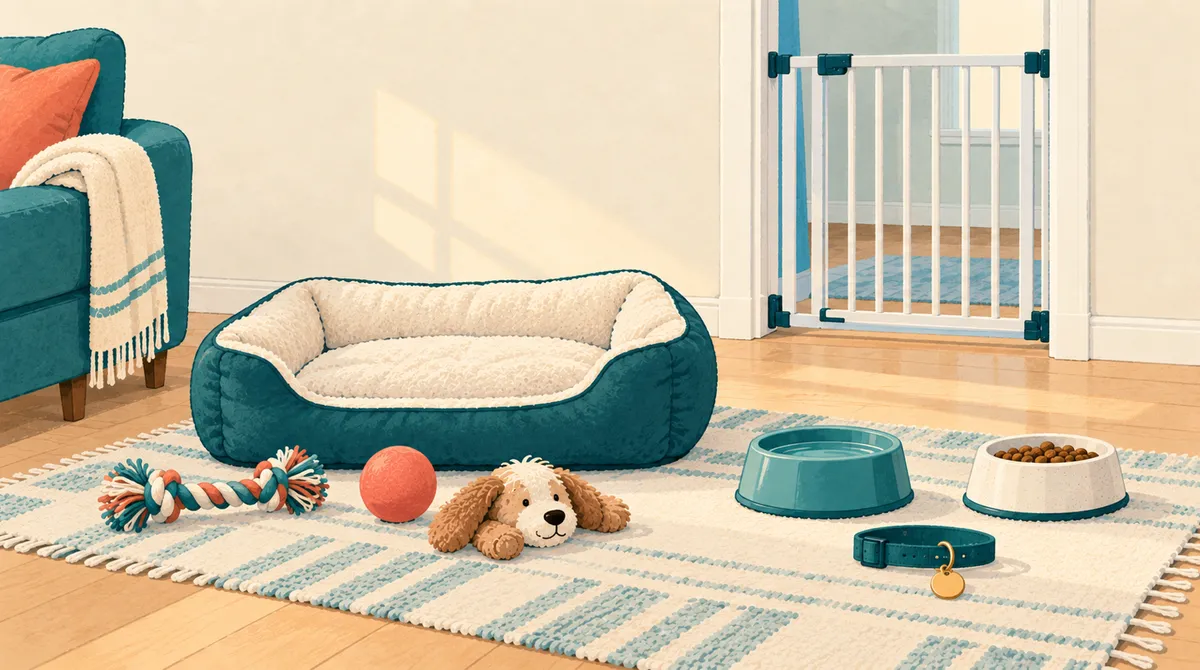
Then stock that space. The AKC's new-dog checklist (opens in a new tab) covers the gear — a sleeping spot, bowls, a harness and lead, chew toys and treats, and a way to fence off one area — and the same short list works for an adult dog.
Figure 1 · Setup checklist
Six things ready before pickup
Finally, choose the vet before the dog comes home, not after. PDSA's new-owner Q&A (opens in a new tab) suggests registering with a practice before your dog arrives, and asking the breeder, shelter or foster for the paperwork that comes with the dog — vaccination records and microchip details at minimum — so the first visit starts from the record, not from scratch.
Day one: quiet, routine, one room at a time
Keep the first day deliberately boring. Stay home if you can, let the dog explore one room at a time, and skip the welcome party — the AKC's first-day advice is to hold off on inviting friends and neighbours over just yet. Introduce family members one at a time, and take the dog to the toilet spot you plan to use so they can be praised for finding it early.
Figure 2 · The first afternoon
Three steps that keep day one calm
- Arrive into the quiet roomLead off indoors, doors shut, and let the dog sniff and settle before any introductions.
- Out to the toilet spotSame door, same patch, every time — praise when they use it.
- Open the house slowlyAdd rooms over days, not minutes; new smells can wait.
Decide the house rules before the dog tests them — where they sleep, whether they're allowed on furniture, whether scraps exist. The AKC's first-day guidance makes the point plainly: start enforcing the rules from the beginning, because a rule that's consistent is kinder than one that changes. If a resident dog is part of the picture, do that meeting separately and slowly — our introductions guide covers it step by step.
Food, sleep and toilet rhythm
Dogs settle fastest when the day has a shape. Keep meals at regular times — the AKC notes young puppies often eat three times a day — and offer a toilet trip after eating, drinking, waking and playing. Whatever feeding changes you plan, run them past your vet and switch gradually rather than on day one.
Sleep does heavy lifting in week one. The AKC's day-one guidance notes young puppies can sleep 16 to 18 hours a day, and even adult dogs need undisturbed naps while they decompress. Give the sleeping spot somewhere quiet — for the first nights, a crate or bed near yours helps many dogs settle — and hold a consistent bedtime.
A first-day rhythm:wake, straight outsidemeals, each with a toilet breakshort play, then napslast toilet trip, then bed
Registration, microchip and ID basics
Two things make a lost dog findable: a microchip and a tag. The AVMA's responsible ownership guidance (opens in a new tab) recommends microchipping, keeping your contact details current in the chip registry, and fitting a collar tag plus any licence or rabies tags your area requires. If the dog arrived already chipped, ask the shelter, breeder or vet how to transfer the registration to you — and check the details actually changed hands.
Registration and licensing rules differ between countries and regions, so treat this as a week-one question for your vet or local authority rather than a universal checklist item. The same first visit is a good place to ask about vaccination status, parasite prevention, and anything the records don't answer — your vet sets that schedule, not a website.
First walks and gentle observation
First walks are about the neighbourhood, not the mileage. For a puppy whose vaccination course is still running, the AKC's first-day guidance advises holding off on contact with unfamiliar dogs and busy dog-walking routes until the course is done — your vet confirms the timing. For an adult dog with finished vaccinations, ordinary lead walks can usually start straight away. Keep outings short, let the dog set the pace, and treat week one as observation week.
Watching is the useful part. Notice how the dog recovers from a startle, whether they check in with you, and what pulls their attention — our guide to reading dog body language in context helps you describe what you're seeing without over-reading it. When you're wondering how much walking is enough, the exercise guide explains why there's no single number and how to read energy, age and build.
By day two or three, once the dog is relaxed enough to stand still, take a photo in decent light. A photo observation can list the visible traits — coat, build, ear set — and gives you a concrete record of your new dog as they are right now. Readings are AI-generated and provisional, and a photo shows appearance only, not health, temperament or ancestry — so it's a starting note, not a verdict.
When to call the vet in week one
Book the first check-up inside the first week — the AKC's day-one guidance suggests the vet sees a new puppy within the first few days, and the same logic serves an adult rescue. Bring the vaccination and microchip paperwork you collected so your vet can confirm what's done and what's still due.
Figure 3 · Vet questions, not wait-and-see
Phone the practice if week one brings
- A dog who won't eat or drink across a day, or repeated vomiting or diarrhoea
- Coughing, breathing effort, or an injury you can see
- A dog who seems suddenly much worse rather than slowly settling
- Anything that worries you enough to search for an answer
If you're unsure whether you're looking at nerves or illness, phone the practice — that's exactly what vets are for.
A useful handoff: One quiet space, a predictable rhythm, the chip and tag sorted, a vet booked — the rest of week one is just letting the dog learn that the routine repeats.
Sources
- Your first day at home with a new puppy (opens in a new tab) — American Kennel Club: limited access, the toilet spot, quiet introductions, the first-day rhythm, and the early vet visit.
- New puppy checklist: gear you'll need (opens in a new tab) — American Kennel Club: the supplies worth having ready before pickup.
- Responsible pet ownership (opens in a new tab) — American Veterinary Medical Association: microchipping, registry details, ID and licence tags, and partnering with your vet.
- Vet Q&A: common questions from new puppy owners (opens in a new tab) — PDSA: registering with a practice and the paperwork to bring.
Sources last checked 2026-10-01.
Settling in this week? When the dog is relaxed enough for a photo, Dog Says Hi's photo observation can list the visible traits as a record of your new dog right now — the photo is sent only after you explicitly submit it, and the AI-generated reading is provisional and can be wrong or incomplete. For health concerns, contact a veterinarian.
Related reading
Around the first week: the meeting that came before, and the meetings still to come.
 Meeting a dog before you adoptWhat a shelter visit can show, and the questions worth asking.
 Introduce dogs at their paceWhen a resident dog is part of the first week.
 How much exercise does a dog need?Reading energy, age and build once the first days settle.
Spotted an error? Tell us.